Ravello
The garden town
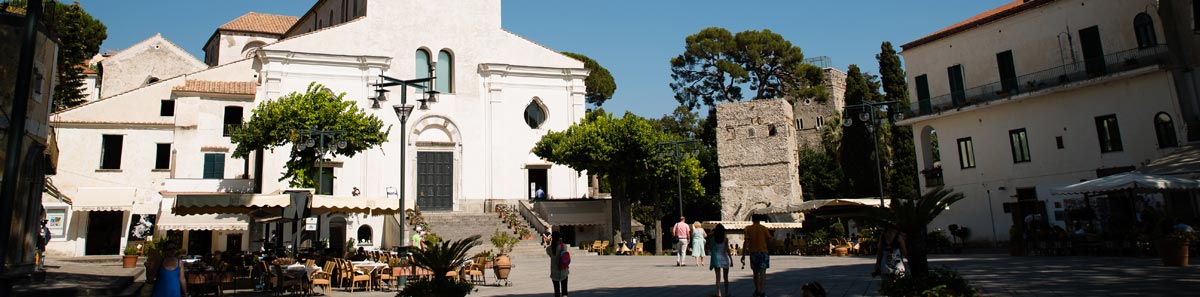
Ravello, located at the top of the Dragone Valley,
really seems as though it is a town and a garden at the same time.
Enclosing an endless number of amazing views, and examples of traditional
architecture, the beauty of Ravello has been charming travelers
and artists of all nationalities for decades. Among the famous artists
who visited Ravello are Boccaccio and Wagner.
Ravello was founded by the Roman aristocracy and soon became
a very wealthy and powerful town, especially between the X and the XIII century.
Ravello owed its prosperity to its extensive commerce
throughout the Mediterranean and to its textile industry
(wool and cotton). The fall of Ravello's wealth and influence came
with Ruggero II and the Normanni domination. This was furthered
even more with the Pisani invasion in 1337, which deprived the entire
Amalfi Coast of its independence and political power.
The famous villas in Ravello are Villa Cimbrone and
Villa Rufolo. These buildings perfectly represent the architectural
style which is typical of the Amalfi Coast.
With its luxurious hotels, culture, cuisine and more, Ravello
has everything it takes to charm its visitors.






 Villa Rufolo was built between the XI, and the XIII century, when Ravello was founded by Roman aristocrats. The Villa is a standing example of the Arabian style architecture that was typical in the south of Italy during the Norman domination.
The beautiful gardens and the view of Villa Rufolo, that have bewitched so many travelers, were also the source of inspiration for the famous Richard Wagner, who used his experiences from the Villa to compose his “Parsifal”.
Villa Rufolo is also mentioned in a famous work of Italian ancient literature, the "Decameron", by Giovanni Boccaccio.
The view from Villa Rufolo's terrace is a must see in Ravello, like the Villa Cimbrone's "Terrace of Infinity", and it is the perfect setting for the festival of classical music that is held there each year.
Villa Rufolo was built between the XI, and the XIII century, when Ravello was founded by Roman aristocrats. The Villa is a standing example of the Arabian style architecture that was typical in the south of Italy during the Norman domination.
The beautiful gardens and the view of Villa Rufolo, that have bewitched so many travelers, were also the source of inspiration for the famous Richard Wagner, who used his experiences from the Villa to compose his “Parsifal”.
Villa Rufolo is also mentioned in a famous work of Italian ancient literature, the "Decameron", by Giovanni Boccaccio.
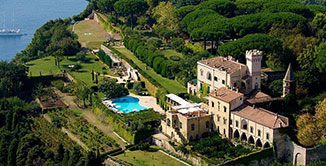
The view from Villa Rufolo's terrace is a must see in Ravello, like the Villa Cimbrone's "Terrace of Infinity", and it is the perfect setting for the festival of classical music that is held there each year. The origin of Villa Cimbrone dates back to the one of Ravello in the 11th century, when some roman aristocrats, escaping
from Rome, decided to build a city that had to be independent from the Republic of Amalfi and heavily fortified. The name of the villa derives from the latin "Cimbronium", the ancient name of the estate that used to include it. Cimbrone
has always been famous for its garden and flowers, plus the villa itself is a very interesting structure, rich with details and decorations, such as the Luca della Robbia terracotta tile and the basreliefs decorating the entrance cloister. Villa Cimbrone was purchased at the end of the 19th century by Lord Grimthorpe. Grimthorpe was an English gentleman who took the beautiful
piece of land that the Villa is located on, and transformed his own vision of the Villa, with the help of a local named Nicola Mansi, turning it into what it is today. Cimbrone's gardens are an everlasting example of beauty, and grace. The atmosphere of the crypt is also very charming, as the one of the Alley of Immensity that leads to the Terrace of Infinity, so
renouned for the breathtaking view on the coast below. Copies of famous statues from the classic tradition and quotes from ancient poets and philosophers also decorate the villa and its gardens.
The origin of Villa Cimbrone dates back to the one of Ravello in the 11th century, when some roman aristocrats, escaping
from Rome, decided to build a city that had to be independent from the Republic of Amalfi and heavily fortified. The name of the villa derives from the latin "Cimbronium", the ancient name of the estate that used to include it. Cimbrone
has always been famous for its garden and flowers, plus the villa itself is a very interesting structure, rich with details and decorations, such as the Luca della Robbia terracotta tile and the basreliefs decorating the entrance cloister. Villa Cimbrone was purchased at the end of the 19th century by Lord Grimthorpe. Grimthorpe was an English gentleman who took the beautiful
piece of land that the Villa is located on, and transformed his own vision of the Villa, with the help of a local named Nicola Mansi, turning it into what it is today. Cimbrone's gardens are an everlasting example of beauty, and grace. The atmosphere of the crypt is also very charming, as the one of the Alley of Immensity that leads to the Terrace of Infinity, so
renouned for the breathtaking view on the coast below. Copies of famous statues from the classic tradition and quotes from ancient poets and philosophers also decorate the villa and its gardens. Local wines of Campania are Falanghina, Fiano, and Greco di tufo, in the whites' department, while the region's reds are the Aglianico, which is named after its grape like Falanghina, the Taurasi, the Per'e Palummo, and the Lacrima Cristi (Christ's tear). The original grapes used to make these wines originally came from Greece, together with the know-how to grow them and to turn them into wine. The whites of the area are quite fruity and fresh, and they ideally go with fish and sea-food. While the Aglianico, Per'e Palummo, and Lacrima Cristi are robust reds with a subtle scent which accompany cured meats, ham and salame, and typical cheese such as caciocavallo, provolone, and provola affumicata (smoked cheese). The Taurasi instead stands out among the region's reds as the special reserve. In the last two decades the wine makers of Campania have generally improved their production process, and added a few new numbers to their repertoire such as rosè, passitos, and a few sparkling proseccos. Make sure you taste them if you visit the Amalfi Coast.