Atrani
The secret gem
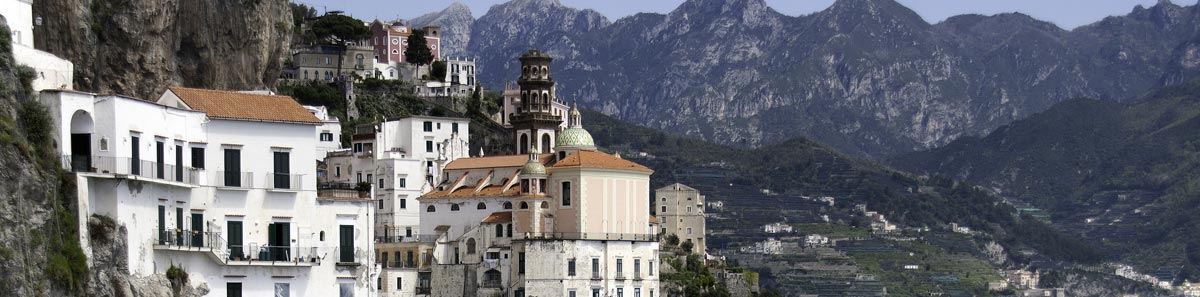
The town of Atrani is located just 700 meters away from
the famous Amalfi. Atrani was founded by the ancient Roman aristocracy,
and became the wealthy residence of the most powerful families of
Amalfi. Unfortunately, the town suffered when Ruggero II, and the
Normanni domination began. This was only furthered with the Pisani
invasion in 1337, which deprived the entire Amalfi Coast of its
independence, and political power.
Atrani, today, maintains it's distinct fishermen's town atmosphere.
The main entrance to the town starts from the beach, and from there,
the traditional houses climb up the steep mountain valley, intertwined
with gardens, and vibrant lemon terraces.
Atrani is away from traffic, and confusion (even in summer), because
it only opens to its beach, and to the sea. This is probably the secret
of its pleasant square which hosts several bars and restaurants. Atrani surely is the place to enjoy a drink or a nice meal in a nice and relaxing atmosphere.

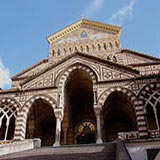
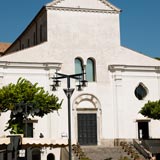
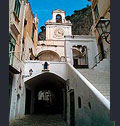 The church of S.Salvatore de'Bireto is in the
main square of Atrani (piazza Umberto I). It was restored, and modified
several times in the neoclassic style, but the original structure
was built in 940. The latest recent renovation brought it back in all its original beauty.
The main door of the church was made in Costantinopoli
in 1087, and ordered by Pantaleone Viaretta, who also donated the
main door of the Duomo of Amalfi 20 years earlier.
The church, S.Salvatore de'Bireto, was also used
by the aristocracy of Amalfi for the elections of the "Dogi
della Repubblica Amalfitana" . When a new Duke, or "Dogi",
was elected, they were crowned with a typical pointed hat during a ceremony that took place in this church. Becoming
a Duke was the highest position attainable in ancient Amalfitan society.
The church of S.Salvatore de'Bireto is in the
main square of Atrani (piazza Umberto I). It was restored, and modified
several times in the neoclassic style, but the original structure
was built in 940. The latest recent renovation brought it back in all its original beauty.
The main door of the church was made in Costantinopoli
in 1087, and ordered by Pantaleone Viaretta, who also donated the
main door of the Duomo of Amalfi 20 years earlier.
The church, S.Salvatore de'Bireto, was also used
by the aristocracy of Amalfi for the elections of the "Dogi
della Repubblica Amalfitana" . When a new Duke, or "Dogi",
was elected, they were crowned with a typical pointed hat during a ceremony that took place in this church. Becoming
a Duke was the highest position attainable in ancient Amalfitan society.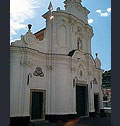 When the town of Amalfi was a republic, Atrani used to be the residence of the Amalfi's noblest families. Here
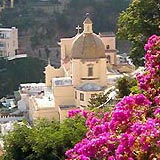
in Atrani the "Dogi" were crowned, and buried. Atrani was completely destroyed by the Pisani army, but the town rose again in 1135. The "Collegiata di Santa Maria Maddalena" (1274) was built in this period, and then bared several modifications. Its front is in southern Italian Barocco style, and its dome, and bell tower soon became the symbol of this small costal town. The church encloses a work by the painter, Andrea da Salerno, l' "Incredulità di San Tommaso".
When the town of Amalfi was a republic, Atrani used to be the residence of the Amalfi's noblest families. Here
in Atrani the "Dogi" were crowned, and buried. Atrani was completely destroyed by the Pisani army, but the town rose again in 1135. The "Collegiata di Santa Maria Maddalena" (1274) was built in this period, and then bared several modifications. Its front is in southern Italian Barocco style, and its dome, and bell tower soon became the symbol of this small costal town. The church encloses a work by the painter, Andrea da Salerno, l' "Incredulità di San Tommaso". Local wines of Campania are Falanghina, Fiano, and Greco di tufo, in the whites' department, while the region's reds are the Aglianico, which is named after its grape like Falanghina, the Taurasi, the Per'e Palummo, and the Lacrima Cristi (Christ's tear). The original grapes used to make these wines originally came from Greece, together with the know-how to grow them and to turn them into wine. The whites of the area are quite fruity and fresh, and they ideally go with fish and sea-food. While the Aglianico, Per'e Palummo, and Lacrima Cristi are robust reds with a subtle scent which accompany cured meats, ham and salame, and typical cheese such as caciocavallo, provolone, and provola affumicata (smoked cheese). The Taurasi instead stands out among the region's reds as the special reserve. In the last two decades the wine makers of Campania have generally improved their production process, and added a few new numbers to their repertoire such as rosè, passitos, and a few sparkling proseccos. Make sure you taste them if you visit the Amalfi Coast.