Amalfi
Where it all began
Breathtaking views, history,
traditions and modern comforts are all represented in Amalfitan
life today, and that gives visitors the chance to spend a relaxing
and exciting holiday at the same time.
Amalfi's origins date back to the first century A.C. when the Roman
aristocracy built luxurious villas in the area. Soon Amalfi, and
its surrounding towns, became refined and well developed communities.
Amalfi prospered mainly because of the wealthy commerce
with other populations around the Mediterranean Sea. Amalfi
owned a powerful fleet and had strong marine traditions
and laws (Tabula de Amalpha). Amalfitans are very proud of their most
famous mariner: Flavio Gioia, the inventor of the compass.
Amalfi gained its independence in 838 fighting the Longobardi and kept it until the Pisan army conquered
Amalfi, between the XI and the XII century. The watch towers, which
are still scattered around the coastline, stay as a charming and
everlasting sign of these conflicts.
With its views, culture, food and more Amalfi surely has what it takes
to charm and surprise its visitors.

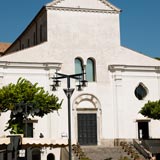
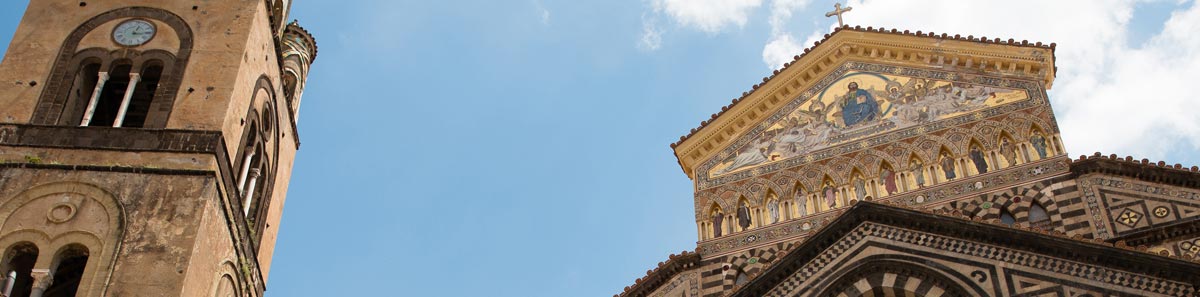
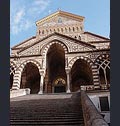 The cathedral is an impressive and complex structure located in the main square of Amalfi. It has ancient origins, and
has been renovated a few times through the centuries. The original
structure dates back to the ninth century, but the church was completely
rebuilt in 1203 in Arabo-Normanno style. The cathedral has been remodeled several times,
adding Romanesque, Byzantine, Gothic, and Baroque elements.The cathedral's front
is rich with many golden mosaics, and it was rebuilt in 1861.
The central mosaic is by Domenico Morelli. The bronze doors of the
Duomo were casted in Costantinopoli in 1066, at the time, the town
of Amalfi was a powerful sea-republic. The doors are decorated with figures of Christ, Mother Mary, and
the Saints Andrea and Pietro. Make sure you visit the Cathedral's crypt, built in 1253, it's a must see.
The cathedral is an impressive and complex structure located in the main square of Amalfi. It has ancient origins, and
has been renovated a few times through the centuries. The original
structure dates back to the ninth century, but the church was completely
rebuilt in 1203 in Arabo-Normanno style. The cathedral has been remodeled several times,
adding Romanesque, Byzantine, Gothic, and Baroque elements.The cathedral's front
is rich with many golden mosaics, and it was rebuilt in 1861.
The central mosaic is by Domenico Morelli. The bronze doors of the
Duomo were casted in Costantinopoli in 1066, at the time, the town
of Amalfi was a powerful sea-republic. The doors are decorated with figures of Christ, Mother Mary, and
the Saints Andrea and Pietro. Make sure you visit the Cathedral's crypt, built in 1253, it's a must see.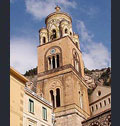 The bell tower is located to the left of the cathedral, it has kept its original style, and structure, in spite of many renovations.
The tower is a mixture of Norman and Arabic styles with its double and triple light windows and its majolica domes. It
was built between 1180 and 1276, and it was also used as a defensive tower against the Angioini in 1389.
The bell tower is located to the left of the cathedral, it has kept its original style, and structure, in spite of many renovations.
The tower is a mixture of Norman and Arabic styles with its double and triple light windows and its majolica domes. It
was built between 1180 and 1276, and it was also used as a defensive tower against the Angioini in 1389. Local wines of Campania are Falanghina, Fiano, and Greco di tufo, in the whites' department, while the region's reds are the Aglianico, which is named after its grape like Falanghina, the Taurasi, the Per'e Palummo, and the Lacrima Cristi (Christ's tear). The original grapes used to make these wines originally came from Greece, together with the know-how to grow them and to turn them into wine. The whites of the area are quite fruity and fresh, and they ideally go with fish and sea-food. While the Aglianico, Per'e Palummo, and Lacrima Cristi are robust reds with a subtle scent which accompany cured meats, ham and salame, and typical cheese such as caciocavallo, provolone, and provola affumicata (smoked cheese). The Taurasi instead stands out among the region's reds as the special reserve. In the last two decades the wine makers of Campania have generally improved their production process, and added a few new numbers to their repertoire such as rosè, passitos, and a few sparkling proseccos. Make sure you taste them if you visit the Amalfi Coast.